
Evidence before certainty
Sources, calculations, experience, and forecasts remain distinguishable.
Built by Sustainable Gaps
Transformational Approach combines firsthand experience, current market evidence, visible assumptions, and an interactive model to examine how long-lead equipment could affect a live pursuit.
The model is a planning forecast. It is not a supplier quote, guaranteed outcome, or substitute for project-specific engineering, commercial, and legal review.
Why it matters
This work did not begin as a product pitch. It began as a short validation of a plausible field observation. The evidence strengthened parts of the idea, corrected others, and revealed a useful planning application.
The work began with a supply-chain pattern Erik Herring experienced firsthand during the 2021 disruption.
A five-question review expanded into a dated comparison of procurement activity, market reports, cost indexes, and equipment lead-time records.
Two claims were narrowed after separate evidence reviews. The corrections remain visible instead of being edited out of the record.
The evidence and assumptions became an interactive model that lets a project team examine how timing could change cost and schedule exposure.
The working model
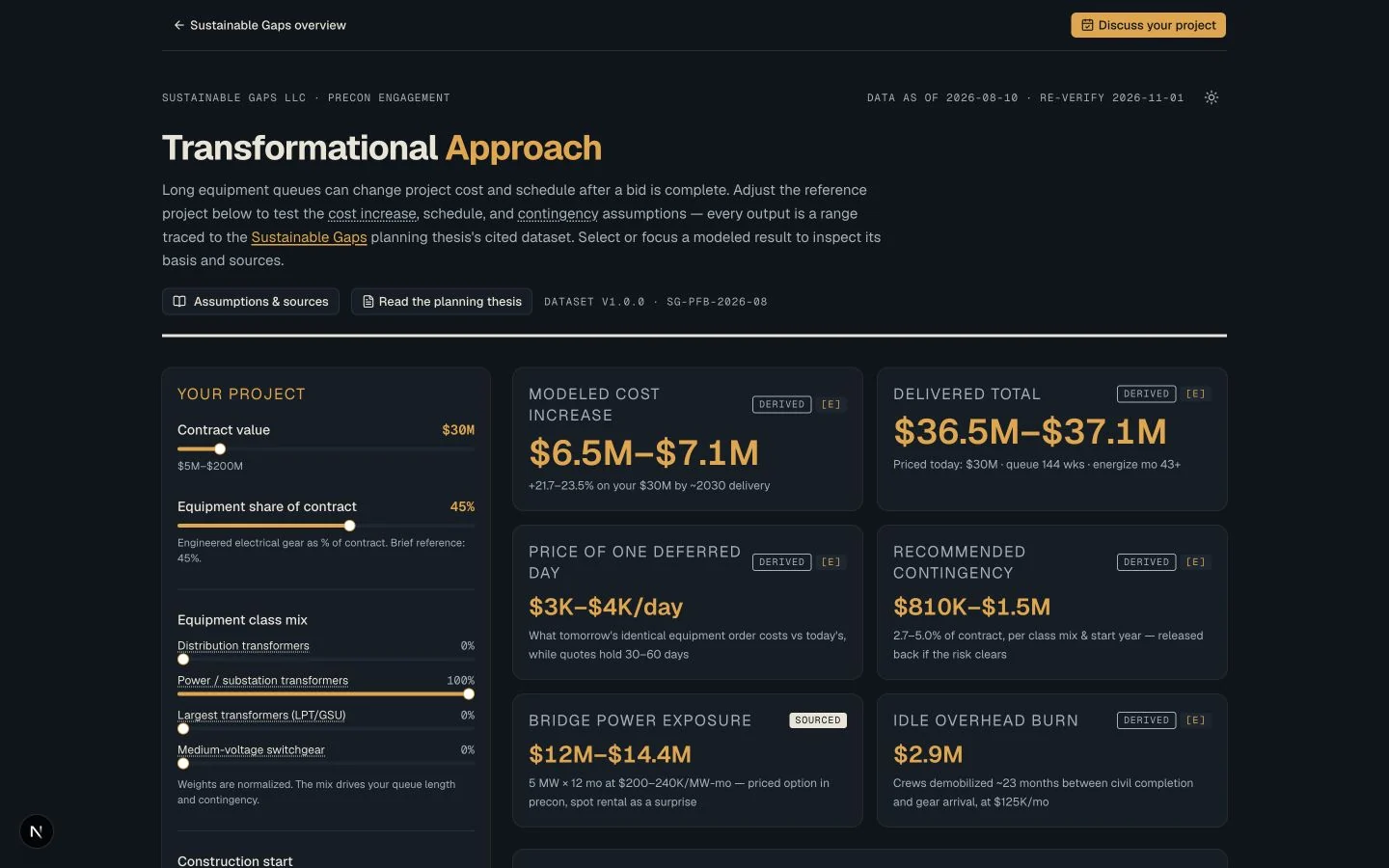
The dashboard lets a project team adjust contract value, equipment share, class mix, construction start, order timing, energization risk, and bridge duration. Every result remains a range with its basis available for review.
What this demonstrates
The deliverable is more than a report. SG follows the question through evidence, correction, calculation, interface design, decision ownership, and a practical path for implementation.
See the Signal Engine behind the evidenceSources, calculations, experience, and forecasts remain distinguishable.
The interface exposes the inputs that matter instead of hiding them inside a fixed answer.
Long-Lead Equipment Exposure Assessment
The assessment replaces the reference model's assumptions with the client's equipment list, schedule, available supplier quotes, and current pursuit records.
Scope confirmed before work begins
The fee, timing, and acceptance criteria are quoted after the pursuit's equipment classes, schedule horizon, available records, and required decision outputs are reviewed. No retainer or follow-on obligation is required.
Planned delivery is within 10 business days after complete inputs are received. Timing and scope are confirmed in writing before the assessment begins.
Start with the decision
Sustainable Gaps will determine whether this assessment fits the situation before a scope is proposed.